

The Guelph Civic Museum’s latest exhibit, Maawnjidyang Maa, decolonizes the story of Guelph’s founding
The Guelph Civic Museum has unveiled their newest exhibition, Maawnjidyang Maa, which means “we come together here” in Anishinaabemowin. It is the work of the Decolonizing Place Narratives Research Collective. The Ontarion interviewed four members of the Collective: Kim Anderson, faculty member in the Family and Applied Nutrition Department of the University of Guelph; Brooklyn Willcocks, the Indigenous community relations coordinator of the museum; Samantha Scott, a student in the Master of Arts in Public Issues Anthropology at the University of Guelph, and Curator Dawn Owen.
The exhibit’s focus is telling the story of Guelph from the perspective of Anishinaabe and Haudenosaunee theory of knowledge with acknowledgement of colonialism’s violence. The pieces highlight the relationship between the land, its plants and those living within it, with a focus on the Eramosa River, Speed River and the Grand River Watershed.
The museum is undergoing a decolonization process as the exhibit seeks to correct the narrative of Guelph’s story. The exhibit’s featured pieces were by artists invited “to co-create with the curatorial team,” Owen said. It is in acknowledgement of how “a colonial museum collection was [not] likely [to] hold the objects that would carry that story well.”
This allowed for the exhibit to feature contemporary Indigenous artists that live within and around Guelph. Anishinaabe and Haudenosaunee voices were included in the planning and making of the exhibit. This inclusivity practice is one that museums are beginning to incorporate more often to heal their relationships with local Indigenous communities.
At the centre of the exhibit is a circular theatre that details the stories of three maple trees. Writings explain one maple tree that fell down from a storm, one was cut down by John Galt as a symbol of a new settlement in 1827, and the third maple tree, which is standing by the hilltop of Guelph, to the left of the museum itself. The tree cut by Galt is featured twice for its symbolism of colonial violence, including an excerpt from one of his writings describing the incident. There’s also a photograph of the plaque commemorating Galt’s act in the centre of town.
The story was found by a team of researchers looking to add a wooden table to the Nokom’s House Research Centre at the University of Guelph. The maple is seen as a leader to the Anishinaabe and Haudenosaunee. The maple tree “provides nourishment (sap) when it is most needed. Here, in this exhibition and in the place we call Guelph, the Maple is both storyteller and witness, bridging past, present and future,” read the exhibit.
There are wooden poles that conceptualize a forest in a way that invites the visitor to take care as they walk around the space. The interaction represents how humans relate to plants, making visitors reflect on their relationship with the land, based on Anishinaabe and Haudenosaunee ways of knowing.
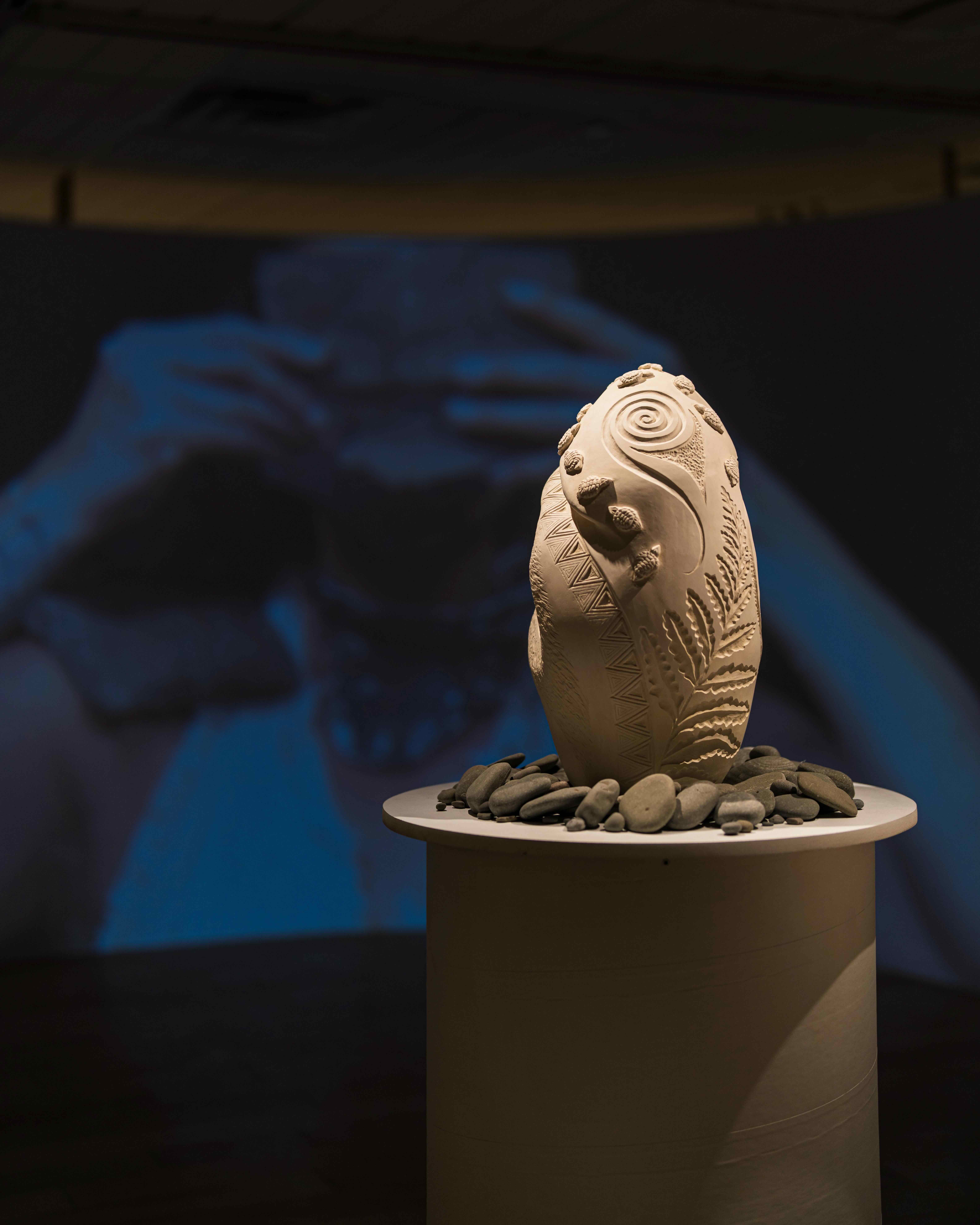
Calming music continually plays in the background featuring notes of water streams and wind, emulating the sounds of a forest. On the other side of the theatre, a projector plays the film Pathways of the Forest by Santee Smith, the footage looping and accompanied with three clay sculptures titled Turtle Rock, Trout Rock and River Rock respectively. There is a nearby sofa to sit, view the film, examine the sculptures and reflect on the room overall. With added soft, yellow spotlights and green walls, the exhibit creates a feeling of immersion in nature, as if on a hike.
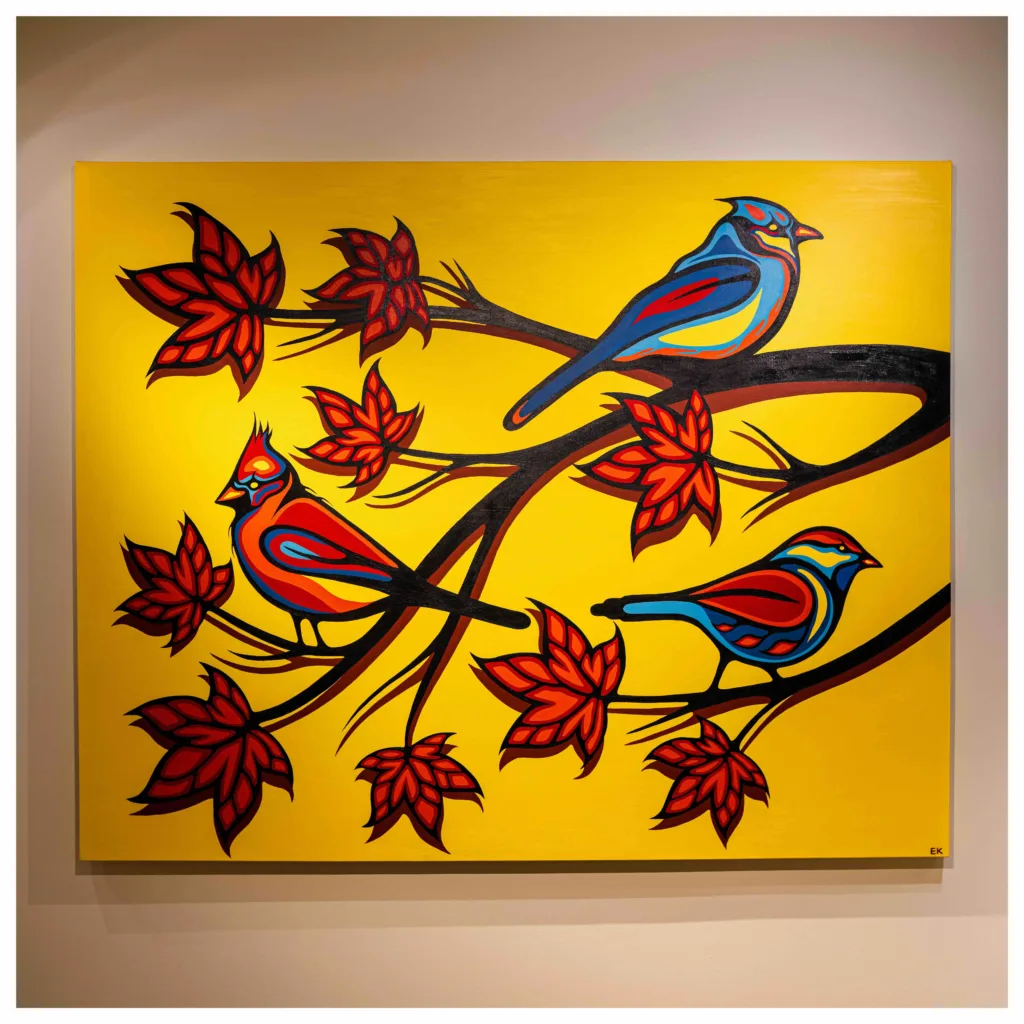
Anishinaabe artist Emily Kewageshig’s piece Between Wind and Sky features a stark yellow background with tree branches and three birds looking opposite of each other. The exhibit’s spotlights are arranged so that they cast a stark shadow on Kewageshig’s work. This is just one example of the team’s incredible light work that brings the exhibit to life. There are many other artists exhibited, including the late steampunk-inspired Rene Meshake.
The museum made sure to attract young voices, which Anderson said was to “understand their vision of Guelph as it goes to the future.” Hanging by the entrance are pieces created by six Indigenous high school students as part of a workshop led by Alex Jacobs Blum. The pieces highlight how the students experience their relations to the Grand River Watershed, particularly the Eramosa and Speed rivers. The personal artist statements add a breadth of life to the voices the museum includes in its exhibit. These are featured as a bundle of papers one can take from a hook to read individually.
Finally, a Moon plaque is updated with the Moon’s phase each lunar month. It reflects how the Anishinaabe and Haudenosaunee honour the Moon phases each month for what it brings to the land; that is, its plants and occupants. This is also displayed near a digital piece featuring the Mohawk Creation Story.
Visitors also have a chance to be added to the exhibit. Part of the museum’s effort to challenge its colonial past is collaboration. The museum will share details in May about a workshop they’ll host for guests. Participants will reflect on their relationship with plants by looking at plants near the museum and along the Grand River. Then, participants will sketch the plant they feel the most connected to, and those pieces will be added to a cabinet near the exhibit. Owen said the idea is based on a “cabinet of curiosities,” which typically held items stolen from colonies for the scientific gaze. The piece challenges this history by asking, “What happens when the [scientific] gaze is turned the other way?” Anderson said. It further tells the story of Guelph from the perspective of the land and its non-human occupants.
Editor’s note: This story is a corrected version of the original print story.