

It’s been two years since we last reported on the Urban Park Guelph proposal. Here’s everything you should know about “the most complicated piece of land ever”
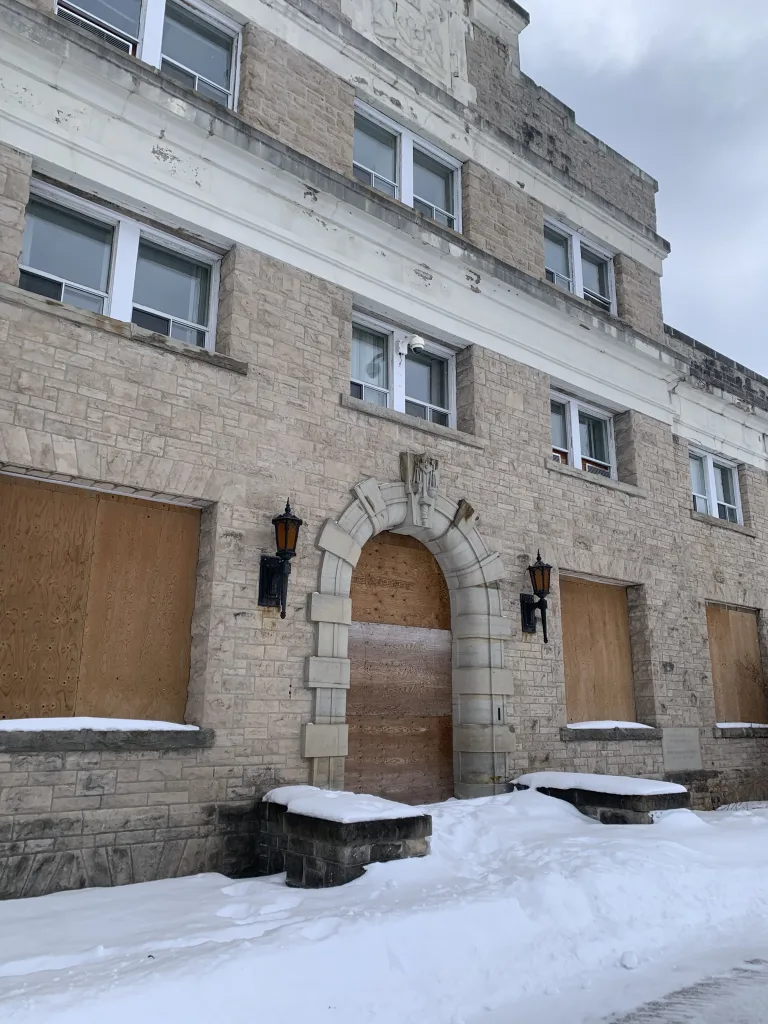
The former Ontario Reformatory site is “the most complicated piece of land ever,” said Mayor Cam Guthrie in a council planning meeting on Feb. 10, during which the lands were officially designated as a Heritage Conservation District (HCD).
Here’s everything you need to know about the district—and advocacy for it to become a future national urban park in the heart of Guelph.
The former correctional facility opened in 1910 and its lands comprised the entire block within Stone Road, Watson Road, York Road and Victoria Road. The reformatory buildings, ponds and lands were entirely built, dug and planted by prisoners. They also erected ornamental gardens, arable fields, orchards and greenhouses on the grounds.
In the name of rehabilitation, inmates were taught employable skills like masonry, machinery, farming and butchery. The reformatory became largely self-sufficient and inmate labour produced textiles, food and even cedar picnic tables for other Ontario prisons. Still, conditions at the facility were harsh, leading to a historic prison riot in 1952.
The reformatory was decommissioned in 2001, and parts of the property that had not been sold became the Guelph Correctional Centre. In 2016, Infrastructure Ontario indicated it intended to sell the property. It is no longer actively listed for sale and the province remains the owner and manager of the property.
Ontario Heritage Act designations
Ontario Heritage Act designations
Heritage designation is critical for the protection of sites like the Ontario Reformatory.
In 2018, Infrastructure Ontario recognized the property at 785 York Road (formerly the Guelph Correctional Centre) as a Provincial Heritage Property of Provincial Significance under Part III of the Ontario Heritage Act. Part III offers heritage protection to provincially-owned lands and thus would not apply if the province sold the property.
In 2021, the province requested that the municipality of Guelph designate 785 York Road under Part IV of the Ontario Heritage Act, which would ensure the long-term protection of specific heritage attributes on the property.
Council passed the motion to do so in June 2021 and unanimously moved to initiate a Part V HCD study for the lands to assess the property’s heritage, cultural and natural value and create a plan for conservation.
Under Part V designation, the entire land area within an HCD boundary is protected and conserved according to a district plan. This designation offers broader protection for the lands surrounding heritage buildings and features, rather than protecting only specific attributes, as in Part IV.
Heritage Conservation District updates
Heritage Conservation District updates
On Feb. 10, 2026, the revised district plan was presented to council with recommendations to designate the Ontario Reformatory HCD boundary and adopt the planning guidelines as by-law.
Section 5.1 of the plan included guidelines and parameters for development “so that City staff have the ability to contemplate and control residential use if it were to arise.”
“We know this is controversial,” said senior heritage planner Stephen Robinson, who stated this section was added due to federal, provincial and local attention to residential housing pressures.
“Staff feel it is important to have in the [Ontario Reformatory HCD plan] policies that address residential, if it were to occur, versus having no policies related to housing, and thus the HCD not being applicable,” Robinson said.
This addition was made despite multiple public comments objecting to residential land use within the district’s boundary. It is also contradictory to the City’s official and secondary plans which do not permit residential development on the land.
Following city staff’s presentation of the HCD plan were two hours of delegations and deliberation from community members and councillors.
Staff were clear this provision was added in the eventuality of the province selling the land to a developer and changing the zoning. If that were to happen, the HCD plan would already include guidelines to control residential development.
But delegates were concerned that adding residential development provisions would be a “self-fulfilling prophecy,” in the words of Brian Skerrett, president of Urban Park Guelph.
Councillor Erin Caton set forward a motion to amend the HCD plan to remove any reference to residential housing, and that staff should bring the amended plan back to a future council plan for approval. That motion passed with Busuttil, Richardson, Chew and Guthrie voting against.
The motion was then to designate the Ontario Reformatory HCD boundary, remove mentions and provisions for residential housing from the plan and bring the plan back to council for final approval. It passed unanimously and the amended plan is expected to be at council for approval in the second quarter of 2026.
Could there be a national urban park in Guelph?
Could there be a national urban park in Guelph?
Parks Canada has committed to creating 15 new national urban parks by 2030, with six sites currently in the pre-feasibility or planning stages. A staggering number of local, provincial and national organizations believe there is potential for a national urban park—connected by a constellation of greenspaces and trails—right in the heart of Guelph.
Their advocacy is led by Urban Park Guelph, which began as a coalition of local groups and has since become a registered not-for-profit organization, with Skerrett as president.
Although the HCD designation protects the land under provincial ownership, it does not guarantee the land will always be free and accessible to the community—especially in the case of a private sale. Establishing a national park with the same boundaries as the HCD would ensure the property remains free to access and offers better protection for natural elements, alongside cultural and heritage preservation.
Potential national urban park sites must meet three objectives: conserve nature, connect people with nature and advance reconciliation with Indigenous peoples. The site has already been identified as a valuable location for environmental conservation and is beloved by community members who frequent the space to walk their dogs, explore trails, ski, ride bikes and fly kites.
As Skerrett and collaborators researched the reformatory’s history, they “came across something that had really not been well documented.” That would be the Native Sons, a group formed in 1975 to provide spiritual practice and education to Indigenous inmates. Skerrett has done significant work to learn the story of the Native Sons, connect with former members and share his findings with the Mississaugas of the Credit First Nations, who are the land’s treaty holders, and the Six Nations of the Grand River.
“This is not about covering up the past in what was at times a brutal institution,” Skerrett said. “This is about acknowledging it.”
The Mississaugas of the Credit and the Six Nations were the first governments to support the national urban park proposal. The Mississaugas of the Credit expressed that they “look forward to being one of the governments developing, guiding and managing this future National Urban Park,” in their letter of support to Urban Park Guelph.
The park has conditional support from Guelph’s elected officials
The park has conditional support from Guelph’s elected officials
In January 2024, former Guelph MP Lloyd Longfield introduced a petition with over 3,100 signatures to the House of Commons, proposing the former Ontario Reformatory lands should be considered as one of Parks Canada’s candidate sites. The federal government responded that “Parks Canada has noted the interest in the proposed Ontario Reformatory Heritage Conservation District in Guelph as a site for a national urban park.”
When the district plan was first considered by council in late 2024, they indicated support for the creation of a national urban park within the Ontario Reformatory HCD boundary “in principle,” but were firm that the creation of such park would be led by the federal government.
MP Dominique O’Rourke and MPP Mike Schreiner both affirmed their conditional support for the urban park in emails to The Ontarion.
As former Ward 6 City Councillor, O’Rourke helped move the motion to support the park in principle. She holds the position that conversation about the reformatory lands’ future use is “largely hypothetical” since it is under provincial ownership. However, she said, “The Old Reformatory lands will benefit from significant natural heritage protections—for the land and key features… [as] it is a special place.”
When asked if she would still support the urban park proposal, O’Rourke said, “If the land is not suitable for another public purpose, for instance as the site of a future hospital, then yes, I support an urban park.”
Schreiner’s office provided this message to The Ontarion: “I support a National Urban Park on the Ontario Reformatory Lands if Guelph General Hospital determines that this location is not appropriate for a new hospital. I cannot endorse the urban park until Guelph General Hospital has received approval and completed its site selection process for a new hospital.”
Mayor Cam Guthrie’s office did not respond to The Ontarion’s request for comment.
If and when Guelph is approved for a second hospital is at the discretion of the Ministry of Health. Officials at Guelph General Hospital (GGH) have noted interest in the OR site for a potential hospital, according to a 2024 letter from GGH to city council that was shared with GuelphToday. Critically, no preferred hospital site has been identified and other potential sites exist.
What the future with a national urban park could look like
What the future with a national urban park could look like
It’s difficult to comprehend the breadth of educational, cultural and recreational activities that can—and already do—take place within the Ontario Reformatory HCD. Establishing a national urban park would offer stronger environmental and heritage protection, increase programming and bring federal investment to the city.
For example, the portion of the district on Stone Road along the Eramosa River is the main location for The Guelph Outdoor School who provides “accessible, nature-based education” to children. Nearby, the quarries offer stellar outdoor concert venues. Guelph band SHEBAD even filmed the music video for their 2024 single “Black Walnut” there.
Skerrett is having conversations with University of Guelph administrators about the possibility of the university backing the project, although they have not confirmed their stance on the proposal. He thinks programs like landscape architecture, history, chemistry and biology could all find curricular inspiration at the site.
The biggest innovation of all would be the national urban park becoming the focal point of a constellation of existing parks, including the Arboretum.
The concept is inspired by the Emerald Necklace park system in Boston designed by landscape architect Frederick Law Olmsted in the late 1800s. It covers 1,100 acres and consists of parks connected by trails, roadways and transit stations.
Some of the parks in Guelph are already connected by trails and rivers, and others have large swaths of greenspace between them that could be transformed into ecological corridors. The potential system would cover a 7 km radius and connect areas like Guelph Lake, Rockwood Conservation Area and the Speed River Trail.
Although it would take years to officially establish the Ontario Reformatory lands as a national urban park, you can start enjoying the site today.
Take a self-guided hike on the Guelph Hiking Trail Club’s 2.49 km Ontario Reformatory trail, or explore a virtual walk hosted by Yorklands Green Hub to learn about the reformatory’s history of production. Paint a portrait of the ornamental landscape, bird watch for one of more than 40 bird species recorded on the grounds and relax with quiet meditation next to the flowing Eramosa River.
“It’s accessible now,” Skerrett said about his hope that students and residents will explore the natural wonder hiding in their backyard. “I think the more [that] people see it and use it and appreciate it, the more they’ll care about it.”