

A club’s innovations means the university doesn’t need to look far for fresh leafy greens for on-campus dining
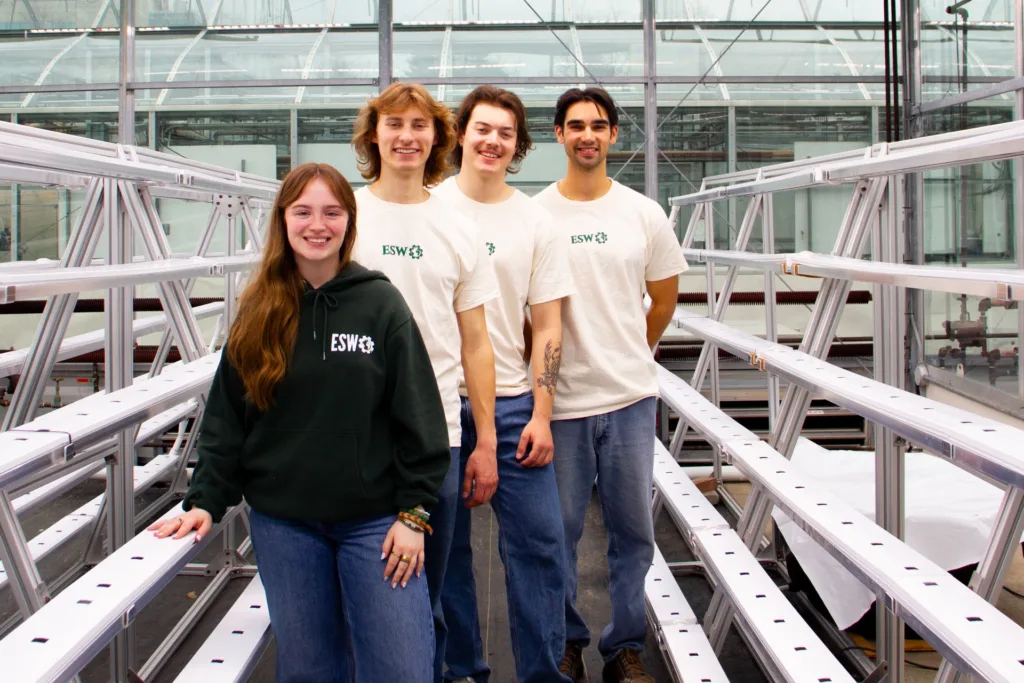
After three years of planning, prototypes and commitment, Guelph’s Engineers for a Sustainable World (ESW) has wrapped up their fully functional, student-built hydroponics system that will provide lettuce for the University of Guelph’s Hospitality Services. Feed the Future is one of ESW’s numerous initiatives working towards a sustainable future.
Hydroponics is a technique for growing plants in a water and nutrient-based solution rather than soil; ideal for locations with limited space and for research in controlled environment agriculture.
At the U of G, ESW is a group of students using their technical skills and education to plan, construct and implement sustainability-focused projects for the community.
Members of ESW met with The Ontarion to discuss the project’s evolution and how its goals were accomplished.
“When we started thinking about hydroponics, ESW wasn’t really a fully functioning club,” said Co-President Alexa Bates. “It’s been really great to see how our whole team has been dedicated to this project for so many years.”
“We found out that Hospitality Services is currently trucking all of their lettuce in from [out of town],” said Co-President Henry Tait. As the ESW team searched for space to begin their project, they were connected with Rodger Tschanz, a greenhouse technician at the Bovey Greenhouse. Tschanz suggested a collaboration with ESW, the Bovey Greenhouse and Hospitality Services to start growing lettuce for on-site dining.
After experimenting with a small-scale hydroponics system, the group was determined to construct their own model. They were granted space in the Bovey Greenhouse to begin their work, which is also where they developed the foundational purpose the project serves today. Their work began with a prototype made from recycled materials that was able to grow 200 heads of lettuce, which were donated to the Guelph Food Bank.
“That was the start of our proof of concept, showing Hospitality Services that we could actually build something, we could grow lettuce, and then go into the process of taking it up a level to [what we have today],” Tait said, while pointing to one of their five-tiered systems. The completed model can grow over 750 heads of lettuce.
Supported by greenhouse staff, university faculty and grant contributors, among others, the team built a system from scratch. Gage Gonsalves, the hydroponics project manager, explained how observing many compounding problems in the beginning gave them insight into how precise the system really was.
“[It was] almost just like building a big Lego sculpture, where you’re putting in piece by piece and gradually building it to how it’s supposed to look,” Gonsalves said.
Adrian Nowaskey, one of the project’s designers, noted that the two biggest milestones of the project was the completion of the frames and the addition of the plumbing system to recirculate and drain water from each layer. He emphasized how much they were able to learn about fluid mechanics from their hands-on experience during the start-up.
“With so many stages, it was the little milestones that got us through and kept us going,” Nowaskey said.
ESW reaches beyond U of G. The club originated at Cornell University and now has 50 chapters across Canada and the United States. The organization connects students, professionals and faculty who believe in the power of youth innovation and collaboration to combat the world’s most pressing environmental issues.
Before graduating from U of G, the members look forward to passing down their hard work and knowledge to fellow club members.
“That’s what’s rare about an ESW project, it’s not just for fun with the team, but it’s actually done with a greater purpose,” Bates said.