

Military reenactment expert answers the question “Why on earth do people do this?”
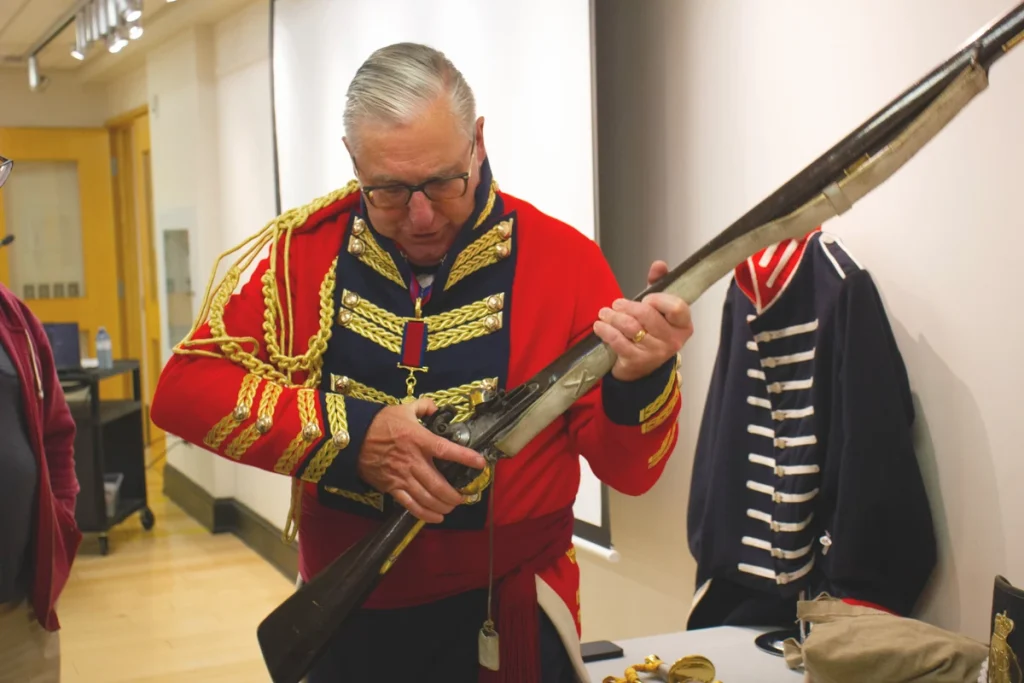
On Oct. 16, the Guelph Civic Museum featured a talk from Tom Fournier, a highly acclaimed military reenactor. With over 20 years of experience, Fournier illustrated his path from private to senior commander for all War of 1812 reenactments portraying British or Canadian soldiers in North America.
Based in Cambridge, Ontario, Fournier emphasizes the plethora of history that surrounds the southern province. In the lecture, Fournier highlighted the importance of historical reenactments, provided insider details and discussed challenges facing the hobby.
Historical reenactors are groups of people dedicated to reenacting events in history in hopes of preserving their historical integrity and educating the public. Analogous to one reviewing a marked exam, reenactment serves as a means to demonstrate errors in history and learn from past mistakes.
As Fournier said, “It’s a lot like camping with a whole bunch of friends, the nuance being every now and then, you’ve got to put that heavy coat on, grab a musket and go shoot at Americans.”
Regarded as a hobby, reenactors carry out historical scenes, playing different roles according to what is recounted. These events are typically hosted at the historical sites where the event took place.
However, not every reenactment is identical from year to year, and some may be improvisations of historical scenes. A typical gathering mirrors a weekend getaway of camping, with events year-round. Accommodations can include anything from a simple canvas tent to restored historical cabins. Rain or shine, reenactors are out in the fields capturing an authentic experience.
“We’ve been there when it’s minus 30 and in a blizzard!” Fournier said.
In 2002, Fournier attended a War of 1812 reenactment as a spectator and was hooked. As a huge fan of historical literature and Napoleonic era history, he described the event as a perfect representation of “the mind’s eye.”
History was not something only present in between pages and books, but could be a living, walking, breathing entity embodied by reenactors. Blaring muskets, thumping drums—Fournier was amazed at watching history unfold and immediately wanted in.
Becoming a reenactor is a huge commitment, not only monetarily, but with ample time dedicated to practice and traveling. Fournier described what the life of a highly involved reenactor entails. As a senior commander, Fournier dedicates roughly an hour every morning to administrative tasks and attends at least one event every month.
“Different people have different levels of participation,” said Fournier. “A lot of musket men, they might do two or three events a year; a couple of events they really want to do and a mix between the really big events.”
Entry-level participants are called privates, and the cost of registering in events includes investing in their own uniform, musket and tents. Climbing the ranks is not as easy as buying a commander uniform, but requires “skill and will,” as illustrated by Fournier. One must have years of dedication and personal expertise on the historical era being represented.
“You talk about not only recruiting and trying to attract people into the hobby and preserve our units, but we also are conscious of retention,” Fournier said.
Although all war of 1812 reenactments aim to preserve historical accuracy and educate those in the present, reenactments come with challenges. Transgressing beyond borders, historical events typically feature both Canadian and American reenactors, each representing a part of history. Now that the U.S. and Canada are experiencing strained relations, it poses the question: has the reenactment community been shaken by political turbulence?
Fournier said, “I’ve been over four times to the U.S., only for reenacting events, because I just don’t want to let a political situation ruin our community and hobby. Everyone was exceedingly friendly and made me feel very welcome.”
Additionally, while the hobby focuses on retention and accuracy, there is a lack of Indigenous representation within the community.
“It’s a shame, because without representation, their story’s not being told and they aren’t portraying their importance in their conflict on both sides,” said Fournier. “We’ve had conversations, tried to work at it, but it ties into themes of colonialism, and their experience with settler conflict hasn’t been a good one, generally speaking.”
Southern Ontario is imbued with a rich War of 1812 history. There are many historical reenactment events one can attend across the province, such as the Annual Siege of Old Fort Erie in Niagara and the Battle of Stoney Creek in Hamilton.