

“Nothing’s riding on this except the first amendment to the Constitution, freedom of the press, and maybe the future of the country.”
Robert Redford, an actor, director, producer and activist, passed away on Sept. 16. His belief in the powers of storytelling and truth shaped the production of All the President’s Men as well as a generation of viewers. It was his dogged desperation to bring the story of Watergate to the big screen that resulted in the creation of this investigative thriller, and his performance was filled with the sort of quiet integrity that to this day makes audiences believe the world can still be changed by decency.
All the President’s Men has maintained cultural relevance and resonance long after its 1976 release, drawing parallels to the modern landscape. It’s clear Redford’s legacy is not just in the roles he played, but in the care he took in telling stories that mattered. Viewers should count themselves lucky that he told this one.
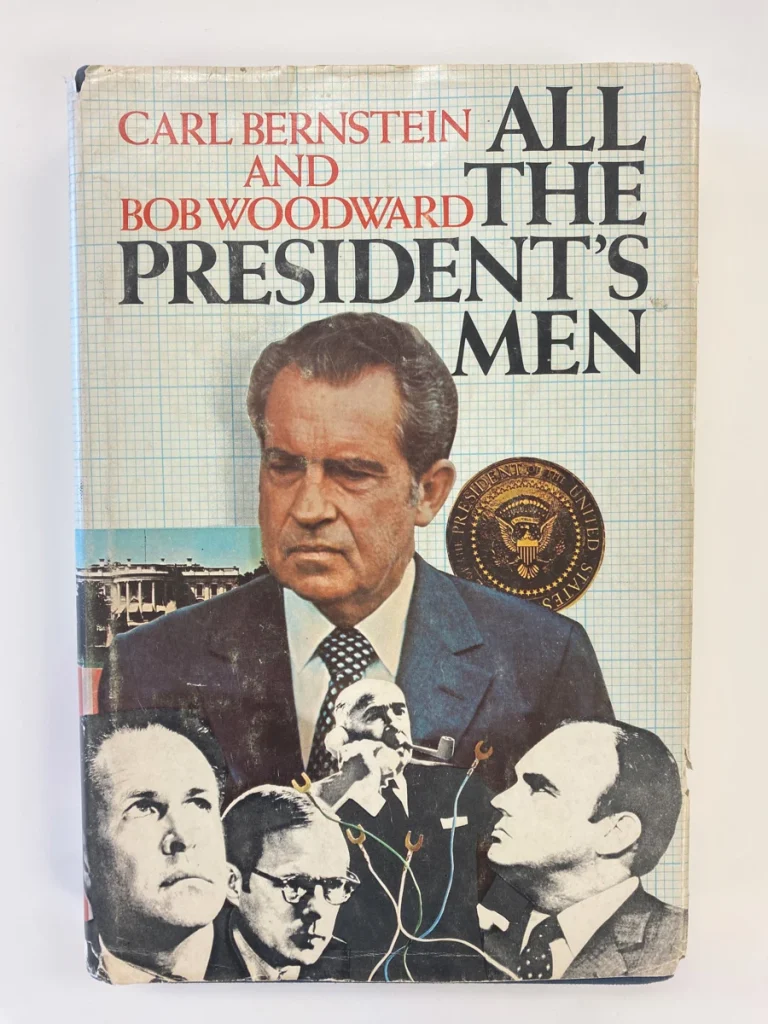
Based on the 1974 book of the same name by Washington Post reporters Bob Woodward and Carl Bernstein, All the President’s Men follows the early days of their uncovering of the Watergate scandal. For those unaware: on June 17, 1972, burglars broke into the Democratic National Committee office at the Watergate Hotel and attempted to plant listening devices. Woodward and Bernstein uncover throughout All the President’s Men that high-ranking White House officials conducted or approved various modes of sabotage against Democratic causes, all paid for with campaign money.
Pakula’s film starts with the bang of a typewriter. There is one soaring speech and few explosive revelations. Meanwhile, the acting, with Redford portraying Woodward and Dustin Hoffman as Bernstein, is quiet, unglamorous and grounded. In fact, Redford and Hoffman memorized one another’s lines so they could interrupt each other and create a lifelike rhythm and chemistry to elevate writer William Goldman’s already clever script.
From the beginning, the story follows two paths: the investigative and the personal. All the President’s Men is by no means a buddy movie, instead we see the two leads practically intertwined to the point where there is little sense of self. Even their boss, executive editor Benjamin C. Bradlee (whom the excellent Jason Robards portrays in a performance so incredible, it won him a Best Supporting Actor award despite being on screen for fewer than 30 minutes), repeatedly refers to them as the combined surname “Woodstein.”
The portmanteau of their last names does not strip them of individuality so much as acknowledge how the dogged investigative work has forced them into one another’s lives. Woodward and Bernstein go from door to door, phone call to phone call and office to office, getting denied and ridiculed by opposition and allies at once. By tooth and nail, they trail the story all the way to the White House chief of staff, the second most powerful man in America.
Impressive film techniques, such as a “split diopter,” in which half the lens is focused on the foreground and the other on the background, make various appearances throughout the film, a testament to cinematographer Gordon Willis’s talent. Willis is known in the industry as the “Prince of Darkness,” a title he earned through his work on The Godfather and other Pakula films, such as The Parallax View and Klute, and made a name for himself by using a specific shadowy cinematographic style that is simultaneously aggressive and soothing.
The Washington Post newsroom is lit by irritating fluorescents that reflect off the multicoloured desks, representing how within the walls of that room the truth will be uncovered and come to light. In contrast, the parking garage where Woodward repeatedly meets with his shadowy source nicknamed “Deep Throat,” who utters the famous phrase “follow the money,” is so dark it appears as if the characters are being swallowed by shadow.
Woodward and Bernstein, when outside of the newsroom, are made miniscule against towering buildings such as the Library of Congress. This serves as a visual representation of their struggle against the overpowering multi-headed beast of the government.
With a staggering runtime of just under two and a half hours, one would expect a critique of All the President’s Men to mainly revolve around what could have been shaved off to make a shorter film, but this is not the case.
The film leaves us after the two reporters misunderstand a source and publish it. They are blown apart on live television by the White House press secretary, threatened with removal from the story, and essentially left to watch what they have uncovered get swallowed up by a singular mistake. And the film ends there, with President Richard Nixon’s re-election.
Actually, not quite. The film cuts to a teleprinter that begins to rattle off information about various figures resigning and getting imprisoned for Watergate-related crimes, ending with the resignation of Nixon on Aug. 9, 1974. This is about the halfway point of the book. Of course, no one expects a four-hour-long feature film, but perhaps some scenes could have been condensed in order to create a longer, denser version that ends with the resignation of the president. While the film’s length is justified, it’s not hard to imagine what a slightly longer version could have achieved.
It is no wonder this movie remains so firmly implanted among the psyches of those who have seen it.
This film is pertinent to our current time because journalism is dying, and with it, the ability to hold the government accountable. A free press and free judiciary stand as the last two lines of defense against the sort of fascist takeover we see in history books. It is therefore important to watch films that remind us it is possible to hold a neglectful or malicious administration accountable, that their wrongdoing is significant and justice can be served.
Perhaps as a daydream, perhaps as a demand. And All the President’s Men is the perfect example of one of these films.