

Students are accumulating cognitive debt by relying on AI for everything
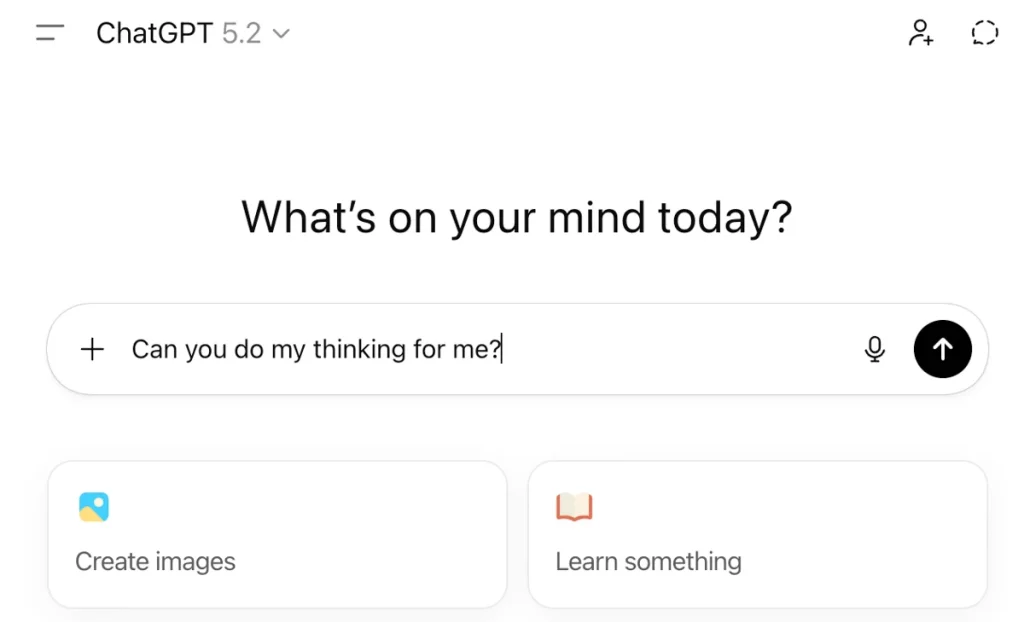
Generative AI is an open secret on university campuses; many students use it indiscriminately to save time completing coursework while they juggle classes. For all we stand to gain from the widespread adoption of AI in academia, I think students should also confront what they stand to lose.
As a writer and editor, I have dutifully held out against using ChatGPT for my work, even though consulting the tool would likely save me hours of mental tinkering. ChatGPT works as a superpowered search engine, idea generator, reader, summarizer, translator, writer and copyeditor. What’s not to love?
I’m definitely not a traditionalist. I take notes on an iPad, write using a laptop and Google questions I could easily ask a human being.
Nevertheless, I struggle to hand over any part of the writing process to AI. ChatGPT costs more than a monthly subscription—it stifles what makes us uniquely human by diminishing our capacity for critical thinking, creativity, memory and agency.
Last year, researchers at the Massachusetts Institute of Technology (MIT) conducted an experiment to measure the brain activity of students writing an essay. Participants were split into three groups and given different tools to complete their assignments. One group used ChatGPT, the second used Google Search, and the third could only use their brains.
The results of the MIT study were revealing: those who used ChatGPT to write their essays exhibited significantly less brain activity than the other groups.
Participants from the study’s ChatGPT group were the most efficient writers, unsurprisingly, considering that ChatGPT can spit out essays in seconds that would take humans hours to research and write.
Despite their efficiency, the ChatGPT group showed the least widespread connectivity across their brains. They struggled to quote from their own essays, which was not observed in the search-engine or brain-only groups, and they internalized information less. ChatGPT users also demonstrated less agency over their work.
Perhaps the most intriguing finding of the MIT study was that essays written with ChatGPT were noticeably homogenous, exhibiting a narrower scope of ideas and perhaps even less critical thinking than the others.
AI can adapt its tone, and with a human’s careful editing and prompting, it can produce half-decent writing. Even with these tweaks, ChatGPT’s writing skews towards the bland and mediocre. It takes billions of webpages worth of training data and reduces thought-provoking questions to predictable, average answers. Of all the losses that we incur by outsourcing our writing tasks to AI, the diversity of thought is one of the greatest.
What the MIT study and anecdotes from regular ChatGPT users tell us is that cognitive debt accumulates each time we ask AI to think and write for us.
Our memory is reduced. Our creativity is sapped. Our ability to approach topics with a critical eye and unique perspective is diminished.
We dissociate from the work we produce and think a little bit more like everyone else. We lose respect for the process of creation, not just for writing, because we fall out of touch with how ideas are generated and nursed to fruition.
Of course, with diligent use, generative AI tools can accelerate learning and increase equity in higher education. Multiple studies suggest that ChatGPT helps undergraduate students overcome language barriers, improving English fluency and writing skills in foreign language learners.
ChatGPT also opens avenues for individualised learning support. Neurodivergent students and students with disabilities may find the tool useful for understanding assignment instructions, creating schedules, transcribing lectures or developing study materials.
That’s to say that the cognitive risks of ChatGPT are not intrinsic. They result from dependency on a tool that should be used to enhance, not replace, our intellectual abilities.
If you insist on using ChatGPT to do your assignments, use it scrupulously, and avoid relinquishing all of your cognitive functioning to your computer. The discomfort of thinking is what makes us human.