

Chappell Roan sets boundaries and speaks out about the normalized culture of the so-called “superfan”
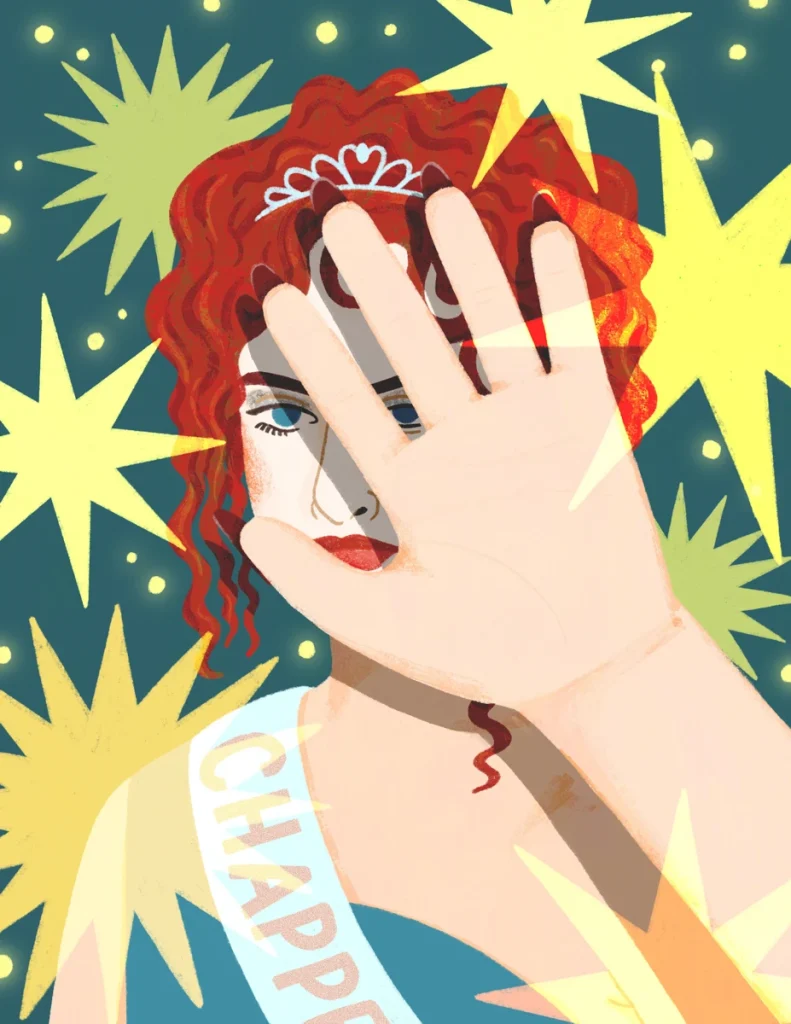
Over the last year, Chappell Roan has skyrocketed to fame with her chart-breaking album “The Rise and Fall of a Midwest Princess” and her single “Good Luck Babe!” She has quickly become a queer icon who has inspired countless people of all ages.
Throughout her increasing popularity Roan has been very candid with the public concerning her struggles with fame and the social implications that come with being a pop star. During one of her concerts in Raleigh, N.C. Roan became very emotional taking in her newfound success.
On stage, Roan said, “I just want to be honest with the crowd, I feel a little bit off today because I think that my career has kind of gone really fast and it’s really hard to keep up and so I’m just being honest that I’m having a hard time today. This is all I’ve ever wanted, so it’s just heavy sometimes. Thank you for understanding.”
Although it seems like Roan jumped out from the queer heavens and right into our laps, producing the most addicting gay pop music, in reality, Roan has been working on her music career for 10 years before the release of “The Rise and Fall of a Midwest Princess.” As a 16-year-old living in Willard, Miss. she started uploading cover songs to YouTube until she was signed to Atlantic Records after writing an original song “Die Young.” However, it wasn’t until after being dropped by her label in 2020 that Roan started working as an independent artist writing songs with songwriter and producer Daniel Nigro.
After promoting her songs “Naked in Manhatten” and “My Kink is Karma” on TikTok and Instagram, Roan found herself opening for Olivia Rodrigo’s SOUR tour in 2022. Needless to say, Roan has put in the work to get to where she is today and has established herself in the music industry.
Unfortunately, Roan’s rapid success has also brought upon the way too normalized culture of so-called “superfans.” This past August, Roan posted a video on TikTok commenting on the inappropriate behaviour she has experienced from fans in public.
“If you saw a random woman on the street would you yell at her from the car window? Would you harass her in public? Would you go up to a random lady and say ‘can I get a photo with you?’ and she says no, would you get mad at her? Would you stalk her family? Would you follow her around,” she questioned.
In any other situation, if a person acted with this behaviour it would be seen as abnormal and dangerous. However, there has been this disconnect which has formed between how fans treat public figures versus how they treat ordinary people in everyday life. Roan’s questions emphasize the fact that such behaviour is intrusive and disrespectful, whether the person is famous or not.
“I don’t care that abuse, harassment, stalking is a normal thing to do to people who are famous,” Roan said in the TikTok. “I don’t care that this crazy type of behaviour comes along with the job I’ve chosen. That does not make it okay, that does not make it normal, it doesn’t mean that I want it, it doesn’t mean that I like it–I’m allowed to say no to creepy behaviour.”
Shortly after Roan expressed these feelings on TikTok people took to social media to describe Roan as being selfish and entitled to think this way. Many comments reminded Roan that she “signed up for this” and that she should “choose a different career.”
This kind of mentality is exactly why it is beneficial to all women that someone with the platform that Roan currently has right now is speaking out about the non-consensual situations so-called “super-fans” have subjected her to. In the grand scheme of things, it is quite absurd how people associate this type of behaviour as just a part of being famous when in reality the idea that we are entitled and owed things by the people whose art we consume needs to be severely reconstructed.
A couple of days after posting her TikTok, Roan took to Instagram to further establish her boundaries with the public and opened the discussion for parasocial relationships. In her post, Roan drew attention to the normalization of harassment and lack of boundaries in fan culture, calling for more respectful and humane treatment.
Roan captioned her post and said, “This isn’t a group conversation. I understand that this is jarring to hear from a person in my position. I’m not afraid of the consequences of demanding respect.”
The post continued, “Just to let you know, every woman is feeling or has felt similar to what I’m experiencing. This isn’t a new situation. If you see me as a bitch or ungrateful or my entire statement upsets you, baby that’s you… you gotta look inward and ask yourself ‘Wait why am I so upset by this? Why is a girl expressing her fears and boundaries so infuriating?’ That is all.”
Her words not only reflect her personal frustrations but also shed light on the stalking and obsessive behaviour that women endure daily. While it’s beneficial that the experiences of famous women can raise awareness of this dangerous behaviour, it’s disheartening to consider how much harder it is for women without the visibility of fame to be believed. Violence against women is at an all-time high globally, regardless of class, race, or nationality, and Roan’s willingness to openly set boundaries and call out harmful behaviour, despite the potential backlash, highlights the seriousness of the problem.
By speaking up, she brings attention to the widespread nature of harassment and the lack of respect that women, both famous and ordinary, experience on a daily basis. Her strong position serves as a reminder that society needs to address and change the cultural norms that allow this kind of treatment to continue unchecked.
At the beginning of September, Roan put her words to action on the red carpet at the 2024 VMAs demonstrating that she will not be tolerating any form of harassment from the public.
When a paparazzo screamed “Shut the fuck up” while walking the carpet, Roan responded, “You shut the fuck up! Don’t. Not me, bitch.”
In an interview post walking the carpet, Roan admitted, “This is quite overwhelming and quite scary.”
“I think for someone who gets a lot of anxiety around people yelling at you, the carpet is horrifying, and I yelled back. You don’t get to yell at me like that,” she said.
Her unapologetic reaction has sparked conversations about the expectations placed on public figures, particularly women, to silently endure inappropriate behaviour.
Roan emphasized how empowering it felt to stand her ground.
“I feel very heard and it feels good,” she said. “I think that it’s hard for artists to speak up because they are so scared of their fans hating them.”
What people often fail to realize is that Roan’s actions reflect exactly how a regular, well-adjusted person would act in the face of fame. She hasn’t been media-trained or forced to conform to an image dictated by industry standards; she’s simply being herself, and we need more of that in the public eye.
By staying true to who she is, Roan not only defies expectations but also challenges the idea that artists must sacrifice their dignity for acceptance.