

The protest was one of several to take place on campus since March
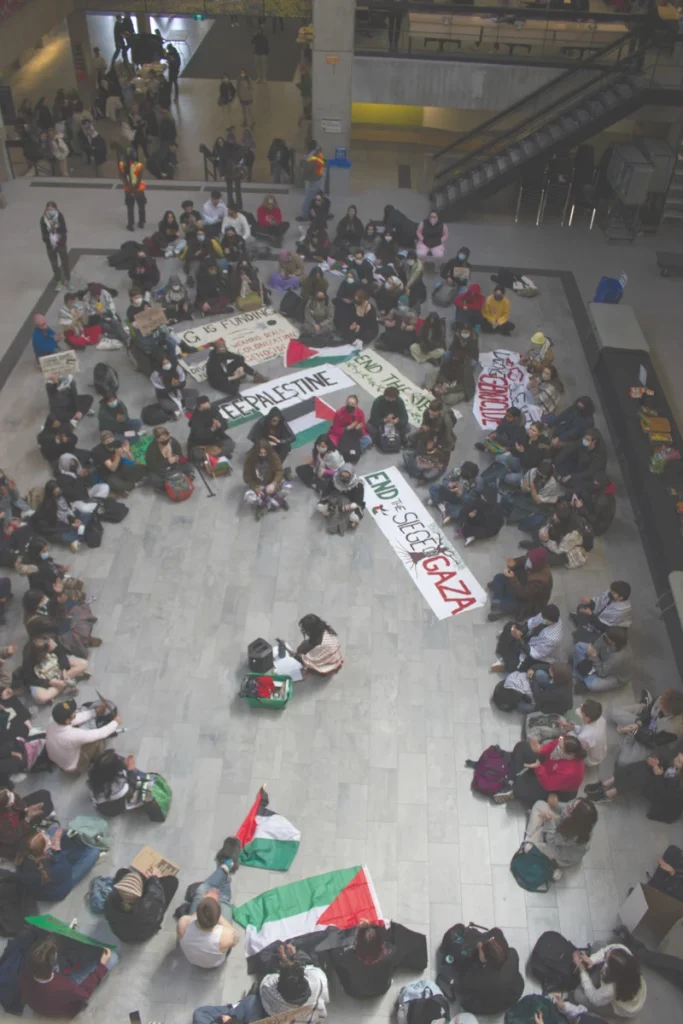
On March 28, a group of approximately 100 protestors organized by UoGForPalestine marched into the University Centre. The group of pro-Palestinian protestors sat on the floor, chanted, and gave speeches demanding the freedom of Palestine and the divestment of funds from the University of Guelph to funding the war in Gaza. The protest lasted an hour.
This followed a March 7 protest, held by Decolonial Solidarity Guelph and UoGForPalestine on campus. The protest was against the Royal Bank of Canada, (RBC), and funding of “the climate crisis, projects that violate free prior and informed consent of Indigenous peoples, and ongoing Israeli apartheid,” according to a brochure from the event.
“That [protest] was mostly led by Decolonial Solidarity Guelph,” said Waida Mirzada, member of UoGForPalestine and organizer of the March 28 protest.
Mirzada said Decolonial Solidarity Guelph and UoGForPalestine share the goal of having RBC leave campus as “RBC profits off the genocide currently happening in Gaza.”
She said that during the protest against RBC, members delivered a letter to the University of Guelph President Charlotte Yates.
Three weeks later, on March 28, a student walkout took place. During this walkout, students heard speakers in Branion Plaza and marched into the University Centre, (UC). During this protest, a petition was submitted to Yates with over 1,200 signatures on it, according to Mirzada.
The protestors, many carrying Palestinian flags and wearing keffiyehs, filled the UC Courtyard and sat in a large circle.
However, not all students attending the protest supported the pro-Palestinian messaging of the large group. A small group of approximately 15 students came out to the student walkout in counter-protest. Many carried Israeli flags, wore clothing with the Star of David, and donned their kippahs.
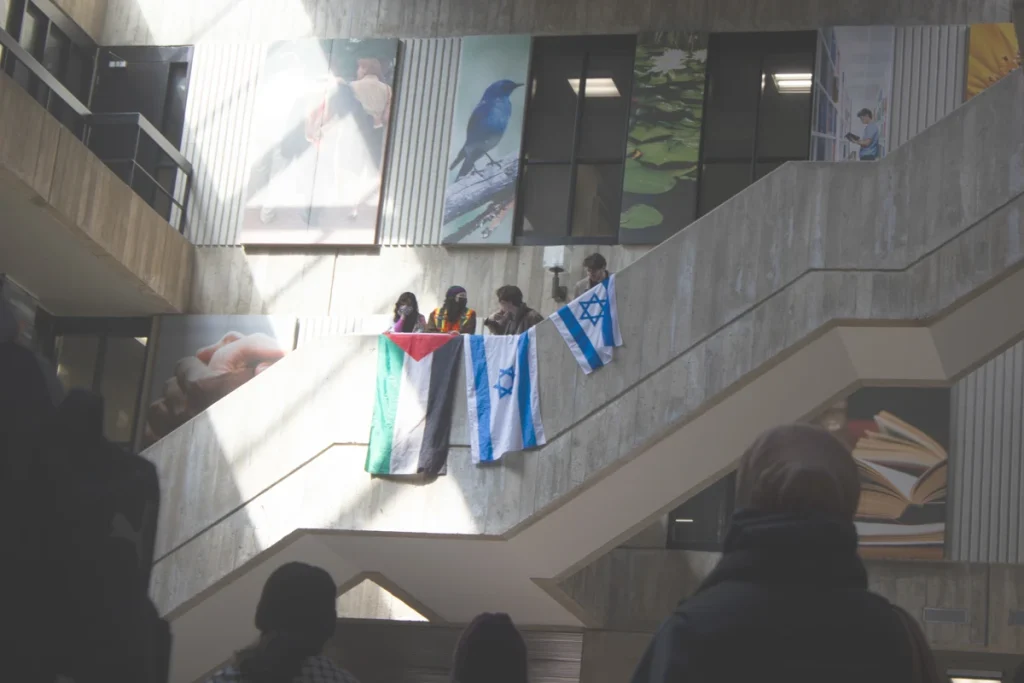
“It was imperative for our community to unite and demonstrate our resilience against these antisemitic remarks,” Daniel Spinner, a pro-Israeli counter-protestor, said to The Ontarion in an email. “We are proud Jews with thousands [of] years of civilized history, we won’t stay silent to hate and bigotry. By counter-protesting together, we aimed to convey that we refuse to be intimidated and that the Jewish community stands in solidarity with Israel.”
Spinner said that the pro-Israeli counter-protestors were waving their Israeli and Canadian flags to “show our solidarity with both countries we consider home, without disturbing the other side’s protest.”
Both Israeli and Palestinian flags were on display while pro-Palestinian protestors were sitting and chanting messages aimed at university administration, voicing frustration on the university’s silence in the wake of the war in Gaza. They also heard from other speakers about their thoughts on what is happening in Gaza.
“We cannot allow this institution to claim political neutrality while it invests in the weapons being used to kill Palestinian’s right now” said one speaker who identified themselves as an organizer with UoGForPalestine and Guelph for Palestine.
Other speakers shared personal stories and details of ongoing and historic events surrounding Palestine, including facts and figures to illustrate their perspective on the conflict.
In an interview with The Ontarion, Mirzada explained that they don’t get their information from one specific source when asked about where they obtain their facts and statistics. She said it is “knowledge that we have ourselves, taking the time to educate ourselves. A lot of it comes from Palestinian scholars and educators and academics… And those are the ones that we amplify”. Mirzada also pointed out Al Jazeera, a news website funded in part by the government of Qatar, as one source of information.
One of the sayings that the pro-Palestinian protestors were chanting was, “from the river to the sea, Palestine will be free.”
“We were disturbed by the lack of empathy and acknowledgement from the university for the chanting of antisemitic slogans, like … ‘from the river to the sea,’ which explicitly call for violence and ethnic cleansing of Jews,” Spinner said.
When asked by The Ontarion what the protestors mean by this slogan, Mirzada said “I can’t speak for everyone in my group… The call to one person’s right to self determination and liberation isn’t a call to an end to another group…And so, there is a distinction to be made between Jewish people who are from that region and also settlers who are occupying Palestinian indigenous land,” Mirzada said.
She explained that she felt that the protest was more a call for the university to divest funds that support the violence occurring in Gaza, and that she felt that having the voices of their group heard was important.
“It’s important for us to use our voices and to stand against genocide – which you think would be the the conscious thing to do,” Mirzada said. “It’s really sad as students that… this academic institution is refusing to take a political stance [and] is remaining silent in the face of genocide.”
A post on Hillel Guelph’s Instagram was made by their co-president on March 28. Hillel Guelph is a chapter of Hillel which supports Jewish campus life across the globe. The Instagram post spoke about the experience the co-president had at the March 28 protest.
The UoGForPalestine-led protest had designated marshalls with reflective vests creating a barrier between themselves and members of the counter protest, along with members of the public and passersby.
“I went to go stand on the other side of the university,” Hillel’s Instagram post reads. “Another protestor in an orange vest pointed at me, and whispered to the people beside them. Now three people are looking and pointing at me. What are they saying? To not let me through? I don’t want to go through, but are they allowed to decide? To police who walks through the University Centre?”
Mirzada had a different perspective.
“Marshalls are always necessary in any movement and it’s to protect everyone’s safety and also to make sure that the reason why we are all organizing is what we are focused on,” Mirzada said.
Spinner said he felt the actions of the marshalls were unfair and against university policy.
“I believe the university must hold them accountable for violating freedom of movement and discriminating against Jewish students,” he said. “At the protest, I attempted to join the crowd but was denied entry by one of the self-proclaimed ‘marshalls’ because of my identity. Additionally, when the crowd moved towards the UC, we were prevented from passing through them. It is a clear violation of the university’s policy and it should be treated accordingly.”
Hillel’s Instagram post said that after the protest, members of the Jewish community came together in a circle and sang Hatikvah, the national anthem of Israel.
Spinner said that “by singing ‘Hatikvah’ after the protest, we felt empowered and reaffirmed [in] our unwavering belief in this enduring hope.”
On Thursday, April 18, a post on UoGForPalestine’s Instagram stated the group was invited to a finance committee meeting on May 30 after interrupting a Board of Governors meeting to demand divestment.
“We can’t wait that long,” the post reads. “We are disappointed that our submission is not on the agenda for the April 22 Board of Governors meeting.”
The post says that going through the finance committee will not lead to any real action until approved by the Board of Governors at a later meeting.