

The banner was hung in the University Centre and MacKinnon on Jan. 11
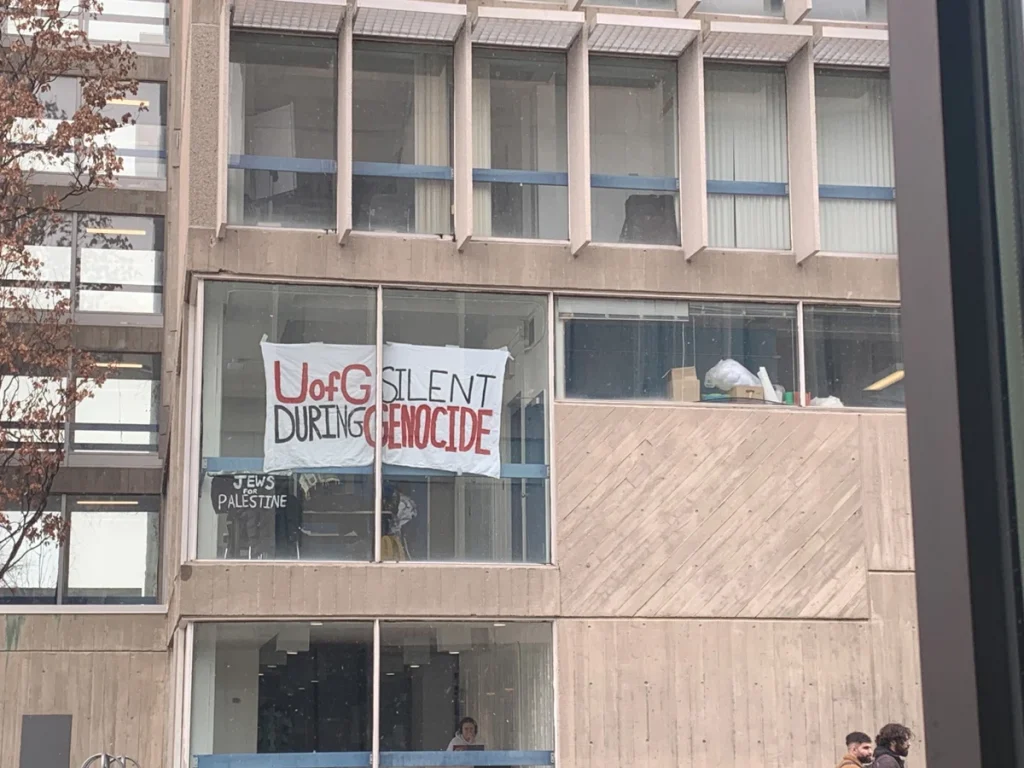
On Jan. 11, a banner was hung in the University Centre on the North end staircase. The banner was painted with words that said “U of G Silent During Genocide.”
It was hung on the day that hearings on a court case brought forward by South Africa at the International Court of Justice, (ICJ), began. In the case, South Africa accused Israel of committing acts of genocide. The ICJ ruled that “at least some of the acts and omissions alleged by South Africa to have been committed by Israel in Gaza appear to be capable of falling within the provisions of the (Genocide) Convention.” The ICJ has since ordered Israel to
take steps to prevent acts of genocide in Gaza.
One of the students behind the banner, Waida Mirzada, believes that the conflict should be labeled as a genocide.
“The plan with the banner was to raise awareness about the silence on campus and lack of acknowledgement from administration surrounding the ongoing genocide of Palestinian people,” she said in an email. “In the last four months we have gotten nothing but absolute silence about the atrocities, killings, displacement, and dehumanization of Indigenous Palestinian people.”
Mirzada said that she felt there was a great amount of support from students and other campus community members.
“Many students mentioned how they also felt silenced on campus and that the banner drop made them feel empowered to continue to speak up about the genocide and know that they are not alone,” she said.
She said the university told her and her group to remove the banners as they were fire hazards.
In an email statement to The Ontarion, Garth Hardie, interim senior director of media relations and stakeholder communications, said unauthorized postings are always quickly removed – urgently if they pose fire or other safety risks.
After being told to remove the banner from the University Centre, Mirzada’s group hung the banner in a window of MacKinnon, facing Winegard Walk, allowing passersby to see the message.
After several hours, Mirzada’s group was asked to remove the banner.
Mirzada said this reaffirmed her belief that the university was structurally gaslighting and stifling the messages of students.
“We feel isolated and upset because thousands of people have died in the last few months and we feel as though we can’t speak out about it or say anything,” she said.
She added that she felt academic institutions should be a place where conversations about happenings around the world, including genocide, should be had. She also pointed out a double-standard when it comes to how the university showed support for Ukraine during the ongoing Russian invasion.
“There is a stark contrast in how the university responded to what was/is happening in Ukraine [versus] Palestine. It solidifies the systemic racism all institutions hold,” Mirzada said. “The university should take a clear stance and help the Palestinian students during this genocide just like it did for Ukrainian students by providing numerous resources and support.”
The university issued statements offering support in relation to the conflicts in Ukraine and Gaza, though the support offered for those affected by the Ukrainian invasion was more detailed. Additionally, the statement on the Ukrainian conflict included a statement of solidarity with Ukraine.
Hardie said that there are different options for students looking to express their views on campus.
“Various forms of expression may be used on our campuses, including peaceful assembly,” he said in the email statement. “Students who are part of Recognized Student Organizations (RSOs) should follow the Student Events and Risk Management process for all event planning (e.g. vigil, student-initiated support groups). Students who are interested in organizing activities and are not a part of an RSO should contact Student Experience Director, Kathryn Hofer, at khofer@uoguelph.ca to discuss event planning and risk management processes.”
He added that the University reserves the right to restrict expression that it reasonably believes violates laws, creates safety concerns, or disrupts the normal functioning of the university.